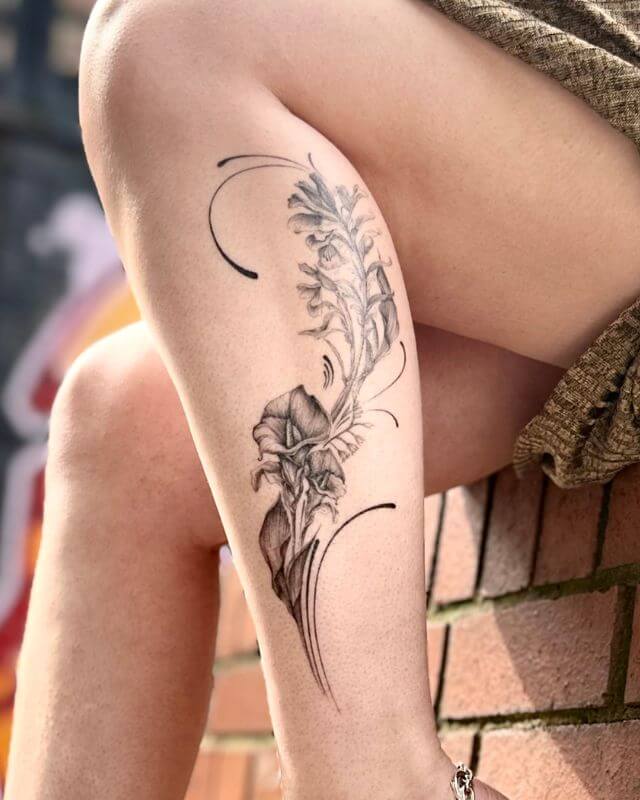
Most aftercare guides cover the first four weeks. They tell you how to wash it, what to put on it, when to stop picking at it. All useful. But they stop at precisely the point where the longer game begins. A tattoo can sit on your skin for forty years. What you do in months two through four hundred matters considerably more than what you do in week one.
This guide is about the long term — the habits that keep a tattoo looking like it was done last year, not last decade. None of them are complicated. Most of them cost nothing.
The Tattoo Is the Beginning, Not the End
There's a tendency to treat the healing period as the whole aftercare story. Get through the peeling, keep it moisturised, don't scratch — done. But healed skin is living tissue that keeps changing. Sun exposure, hydration, weight fluctuation, and time all affect how ink looks embedded in that tissue.
The clients whose tattoos look remarkable at ten or twenty years have typically done a small number of things consistently rather than a long list of things occasionally. The good news: the most impactful habits are also the simplest.
Sun: The Number One Enemy
UV radiation breaks down tattoo ink pigment faster than anything else. It doesn't matter how well the work was done or how diligently you healed it — unprotected sun exposure will fade a tattoo faster than any other single variable. This is not a small effect. It's the dominant one.
Black ink holds best under UV exposure. The carbon-based pigments that make up black are more resistant to UV degradation than the complex molecular compounds used in colour work. Yellows, whites, and pastels are at the opposite end of the spectrum — they can lose significant vibrancy within a few summers of consistent unprotected exposure.
This applies year-round, not just in July. UV index is lower in winter but not zero. If your tattoo is on your forearm and you drive to work every day, the window glass is filtering most UV but not all of it. The cumulative effect over years is real.
Mineral sunscreens (zinc oxide-based) are preferable to chemical ones for tattooed skin — they sit on top of the skin rather than absorbing into it, and they don't interact with the pigments. But any SPF 50+ is substantially better than nothing.
Long-Term Moisturising
Hydrated skin holds ink better. When skin is chronically dry, it loses elasticity and the cell structure that holds pigment becomes less uniform — this shows as dullness and slightly blurry edges rather than clean lines. Keeping the skin around a tattoo consistently moisturised is a low-effort way to preserve the visual quality of the work.
The standard is low. This doesn't need to be a daily intensive routine — normal body moisturiser applied when the skin feels dry is sufficient. A few things that help:
- Fragrance-free formulas are preferable for coloured work, where some fragrance compounds can subtly affect pigment over years.
- Apply after showering while the skin is still slightly damp — it locks in moisture more effectively.
- Shea butter and ceramide-based moisturisers are particularly good for long-term skin health.
- Avoid anything with alcohol as a prominent ingredient — it's drying rather than hydrating.
Touchups: When and Why
Most well-executed tattoos done by a skilled artist don't need touchups for ten to fifteen years, if ever. The healing process is the main determinant of whether early correction is needed — a properly healed tattoo on stable skin has no reason to deteriorate quickly.
Fine line work and light colour pieces may need attention sooner — typically in the five to eight year range for high-movement placements, longer for stable ones. This isn't a failure of the work; it's the nature of the style. Fine lines have less ink volume and less tolerance for the minor migrations that happen in living skin over time.
Signs that a touchup is warranted:
- Visible gaps in linework — not softening, but actual breaks where ink has fully lifted.
- Areas of colour that have gone patchy rather than fading evenly across the piece.
- Significant contrast loss that makes the piece difficult to read at conversational distance.
Touchups on well-executed work are straightforward. Touchups on poorly-executed work are complicated — trying to correct underlying technical problems rather than just refreshing faded work. This is one of the less-discussed reasons why quality of execution matters so much: it affects the maintenance story for the entire life of the piece.
What Placement Has to Do with Aging
Placement is the most fixed variable in the aging equation. You can add sunscreen. You can moisturise. You can't change where the tattoo lives once it's there. Certain placements age considerably faster than others, and understanding why is useful before you commit.
High-movement areas — ribs, hands, feet, inner arms, necks — experience constant flexing that causes ink to migrate slightly over time. Thin skin (top of foot, fingers) provides less support for the pigment layer. Areas with high UV exposure (forearms, shoulders, calves) need more active protection to maintain vibrancy.
Upper arm, thigh, shoulder blade, and upper chest age most gracefully. The skin is relatively stable, movement is moderate, and most of these areas can be protected from sun without significant lifestyle adjustment.
The Honest Truth About Fading
All tattoos change. This is not a flaw in tattooing — it's a property of putting pigment into living, changing tissue. Lines soften over decades. Contrast reduces. Fine detail simplifies. This happens to everyone's work, including the best tattoos in the world.
"The goal isn't to fight time — it's to choose work that ages with dignity. Bold, well-executed pieces do. Rushed, overly detailed fine work in poor placements does not."
The clients who remain most satisfied with their tattoos at twenty years almost always made good decisions at the front end: work that had enough visual weight to age gracefully, placed on skin that would support it, executed by an artist who understood both. The long-term care habits matter, but they're multipliers on a good underlying decision — not substitutes for it.
If you're thinking about a piece that will need to look as good in 2045 as it does today, that's worth discussing at consultation. We can talk through which styles, placements, and approaches tend to carry forward best — and which look extraordinary fresh but require more maintenance commitment over time.